2/26
OTIF ad hoc Committee: 9th session on 23 June 2026 in Bern
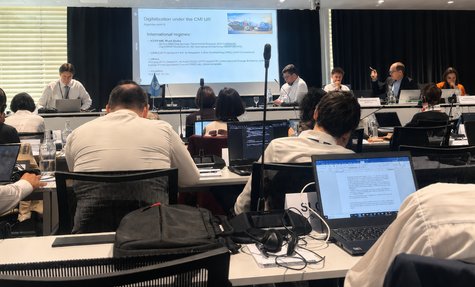
The 9th session of the OTIF Ad Hoc Committee on Legal Affairs and International Cooperation, held on 23 June 2026 in Bern, brought together representatives of OTIF Member States and registered stakeholders from associations to address two key issues: (a) wagon law and (b) digitalisation under the CIM Uniform Rules. The CIT General Secretariat (GS) participated in the discussions, which highlighted both the complexities and the divergent perspectives shaping the future of international rail freight transport regulation.
On wagon law
On the question of wagon law, the OTIF Secretariat introduced a focused debate summarising the details of the round-table discussion on this issue which took place on 15 April 2026. For a full understanding of this issue, it is important to explain that in May 2026 the OTIF Secretariat prepared the working document for this session of 23 June 2026, considering 3 options:
-
Option 1 – make no changes to Article 7 CUV. The OTIF Secretariat proposes potentially considering the desirability of retaining the contractual freedom under Article 7 §2 CUV.
-
Option 2 – provide specifically for latent defects in Article 7 §1 CUV. The OTIF Secretariat proposes inserting an additional sentence in Article 7 § 1 to provide that the keeper specifically is liable for loss or damage caused by a latent defect present on a vehicle, even where the keeper is not at fault.
-
Option 3 – provide in Article 7 CUV for liability for defects on a vehicle causing loss or damage. The OTIF Secretariat proposes here reversing the burden of proof: in relation to defects on a vehicle, that “would reverse the current position under Article 7 §1 and move the burden of proof away from the rail transport undertaking operating the vehicle in such cases”.
The topic having thus been introduced, the subsequent debate concerned the allocation of financial and legal liability for damage caused by wagons, particularly when hidden defects remain undetected by standard visual inspections. Railway undertakings including SBB Cargo and BLS Cargo, alongside representatives from Switzerland, Türkiye and UIC, argued that the current liability regime disproportionately exposes railway undertakings to risk, despite their very limited control over the wagon and its maintenance, or over contractual relationships with ECM and rolling stock manufacturers. They called for a shift towards a stricter liability framework for wagon keepers, emphasizing that those placing wagons in service should bear responsibility for their safe condition. In contrast, UIP and Professor Freise urged caution, warning that a strict keeper-based liability model could disrupt the delicate balance of interconnected responsibilities in railway operations. They pointed to existing legal tools, such as CUV Article 9 §3 and EU law, e.g. the ECM Regulation, as being sufficient to address liability concerns without fundamentally altering the system. While no consensus emerged, the OTIF Ad Hoc Committee agreed on the need for further analysis, including a review of industry practices, potential developments in the GCU framework, and comparative studies with other transport modes. OTIF Member States are expected to submit concrete proposals on a new wording of CUV Article 7 by 31 August 2026, which the OTIF Secretariat will incorporate into a working document for the next session on 3–4 November 2026, with the goal of reaching actionable decisions on revising CUV Article 7.
On digitalisation under CIM UR
The second major topic, digitalisation under the CIM Uniform Rules, proved equally challenging. The OTIF Secretariat presented a meeting document that attempted to align its proposals with European regulations, including eIDAS, eFTI, and TEL TSI. However, the presentation was widely regarded as unclear, mixing various aspects and preventing the OTIF Ad Hoc Committee from making concrete progress. CIT contributed written input, advocating for a coherent approach to the electronic consignment note and warning against the creation of redundant provisions. With no immediate amendments to the CIM UR expected, the OTIF Secretariat will revisit the proposals ahead of the November session. Meanwhile, CIT remains committed to advancing its own work on adapting freight documentation to electronic formats and ensuring compliance with EU law and TEL TSI requirements, in line with its 2026 freight agenda.