4/26
Carrier codes on international rail tickets: legal requirements and sector practice
Carrier codes on international rail tickets: legal requirements and sector practice
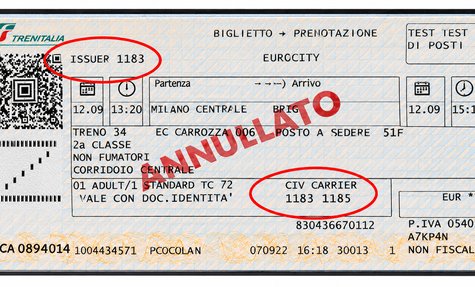
The obligation to indicate carriers on international rail tickets originates in international rail transport law, notably the CIV Uniform Rules. The same approach has subsequently been incorporated into European Union passenger rights legislation and further reflected in sector standards and EU interoperability requirements. This article provides an overview of this legal and technical framework.
From international law to European passenger rights
The legal framework governing the content of international rail tickets is based on both international and European law. At international level, the Uniform Rules concerning the Contract of International Carriage of Passengers by Rail (CIV)[1] establish minimum requirements regarding the content of tickets. In particular, Article 7 § 2 CIV requires that a ticket contain, at least, the carrier or carriers involved in the transport, while Article 7 § 1 CIV leaves flexibility regarding the form and content of tickets and entrusts these aspects to the carrier’s General Conditions of Carriage[2].
At European Union level, Regulation (EU) 2021/782 on rail passengers’ rights and obligations (Rail PRR)[3] builds on this international framework. Article 4 Rail PRR provides that the conclusion and performance of a transport contract, as well as the provision of tickets, are governed by the provisions set out in Annex I to the Regulation. Annex I contains the relevant provisions of the CIV, thereby incorporating them into the European passenger rights framework.
Sector standards for ticket layouts
On the basis of these legal requirements, the international rail sector has developed harmonised standards for ticket layouts and ticket content. These standards are reflected in particular in the CIT Manual for International Rail Tickets (MIRT)[4] and in relevant UIC International Railway Solutions (IRS), notably UIC IRS 90918-8[5].
Within these standards, carriers participating in carriage are typically identified through standardised carrier codes, such as UIC RICS company codes[6] and, in the future, ERA Organisation Codes (OC)[7]. This approach enables consistent identification of carriers across different railway undertakings, ticketing systems and distribution channels while supporting interoperability in international rail transport.
Interoperability requirements under the TEL TSI
The sector approach has subsequently been incorporated into the European interoperability framework. Commission Implementing Regulation (EU) 2026/253 on the telematics subsystem of the rail system in the European Union (TEL TSI)[8] establishes harmonised requirements for ticketing and data exchange.
The TEL TSI refers to ERA Technical Document B.11 – “Layout for electronically issued rail passenger tickets”[9], which reflects established sector solutions, including UIC IRS 90918-8 and the CIT MIRT. For both Non-integrated Reservation Tickets (NRT) and Integrated Reservation Tickets (IRT), carrier identification is achieved through carrier codes displayed in designated ticket fields. These requirements apply across different ticket media, including tickets displayed on mobile devices.
Transparency towards passengers
While the use of carrier codes is a long-established and widely recognised practice in international rail transport, questions are occasionally raised regarding their comprehensibility for passengers. In this context, transparency of passenger information remains important.
Information enabling passengers to identify the relevant carrier may be provided through conditions of carriage[10], websites, booking channels and other customer information tools.
As the sector progressively moves from legacy company codes towards ERA Organisation Codes, discussions on carrier identification and passenger information are expected to continue in parallel with the implementation of the TEL TSI framework.
************************
[1] https://otif.org/en/?page_id=172.
[2] The definition of “General Conditions of Carriage” is included under Article 3(c) CIV.
[3] https://eur-lex.europa.eu/legal-content/EN/TXT/HTML/?uri=CELEX:32021R0782.
[4] https://www.cit-rail.org/en/passenger-traffic/products/.
[5] UIC IRS 90918-8: Layout for electronically issued rail passenger tickets, Rail Combined Ticket 2 (RCT2), Rail Credit Card Sized Ticket (RCCST) on secured paper, A4 Rail Ticket (A4RT), Flexible Size Ticket (FST) and Universal Rail Ticket (URT) on blank paper or on screen.
[6] https://uic.org/support-activities/it/rics?recherche=RICS%20codes.
[7] https://www.era.europa.eu/domains/registers/ocr_en.
[8] https://eur-lex.europa.eu/legal-content/EN/TXT/?uri=CELEX:32026R0253.
[9] Available here: https://gitlab.com/era-europa-eu/public/era-telematics-tsi/tsi_telematics/-/blob/main/pdf/ERA_TD_B11.pdf?ref_type=heads.
[10] See as an example the CIT General Conditions of Carriage for Rail Passengers (GCC-CIV/PRR) and here point 5.1.3.