
2/26
Use and content of the CIM Consignement note: practical question from a CIT member
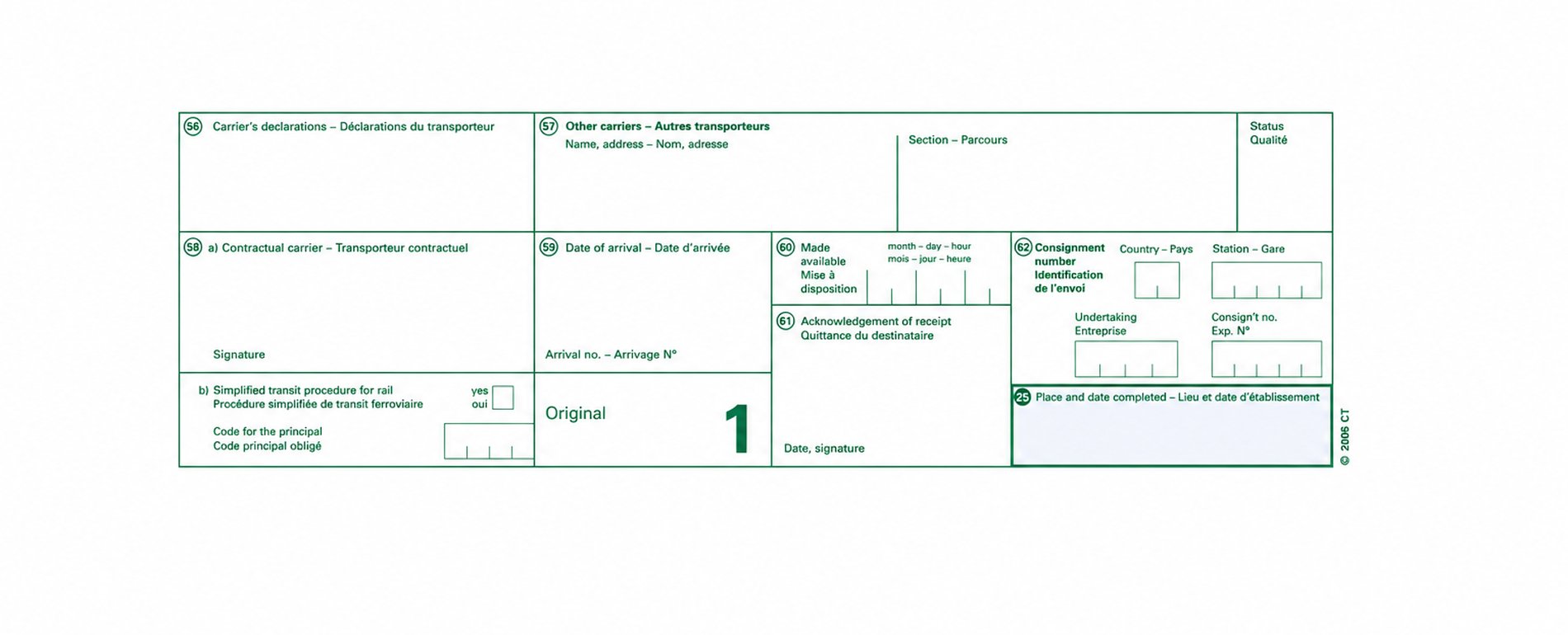
Responsibility for the details and information specified in the CIM consignment note (Art. 7 CIM) lies with the consignor (Art. 8 CIM). The contractual carrier may have the option to include more details in the CN under Art. 7 §3 CIM: “The parties to the contract may enter on the consignment note any other particulars they consider useful”. However, legal and operational complexity should not lead the carrier to make provisional or hypothetical additions to the consignment note.
The operational complexity and numerous assumptions involved in reconfiguring loose wagon trains should not be included in the CIM consignment note generated, as this could lead to uncertainty and legal issues, and incorrect information could be provided. The contractual carrier is under no obligation to indicate substitute carriers on the consignment note, unless otherwise agreed with the other carriers involved. For wagonload, the simplest approach is to use one consignment note per wagon. If we keep the various categories of carrier in mind, the following breakdown is the most appropriate:
-
Firstly, there is the contractual carrier (Article 3 a) CIM) with whom the customer concludes the contract of carriage. The contractual carrier doesn’t necessarily have to be the first carrier in the chain of carriers, however. Indeed, it is even possible that the contractual carrier takes no part in the carriage at all but assigns his responsibilities to other carriers.
-
Secondly, there is the successive carrier (Article 3 a) CIM) who performs part of the carriage as a member of the chain of carriers. Together with the contractual carrier he is party to the contract of carriage with the customer and is liable vis-à-vis the customer for the performance of the whole contract of carriage. In legal terms, the first carrier in a chain of carriers is also a successive carrier.
-
Thirdly, there is the substitute carrier (Article 3 b) CIM) to whom the contractual and/or successive carrier have entrusted the carriage in whole or in part. The substitute carrier is not a party to the contract of carriage with the customer and hence is not liable for the whole carriage but only for his own performance. Unfortunately, the term in German “ausführender Beförderer” [implementing carrier] is unfortunate, indeed misleading. The French and English terms “transporteur substituté” and “substitute carrier” provide a better description. Lastly, there is the auxiliary (Article 40 CIM) to whom the contractual and/or successive carrier or substitute carrier entrust performance of the carriage without that fact being manifest in the consignment note. The auxiliary has no (contractual) liability vis-à-vis the customer, only the carrier who commissioned the auxiliary is liable in contract and in fact exclusively liable. A logical differentiation between the boxes on the consignment note follows from this summary of the types of carriers:
-
The contractual carrier is always shown in box 58 of the CIM consignment note, no matter whether he is also a (successive) carrier and no matter what role he plays in the chain of carriers.
-
All the successive carriers are shown in box 57 of the CIM consignment note (with the exception of the carrier who is the contractual carrier), together with all the substitute carriers.
-
Carriers who are auxiliaries are not shown in any of the boxes of the CIM consignment note.
For further details on the various entries on the CIM consignment note depending on the model of transport, please consult CIT Circular Letter 12/2022 (Models of Carriage and Entries in the Consignment Note) and CIT Circular 7/2015 (Performance of International Carriage of Goods by Rail – The Sub-Contracting Model). To obtain these documents, please contact administration@cit-rail.org.